
Harvard Brings Greek Cuisine to Campus
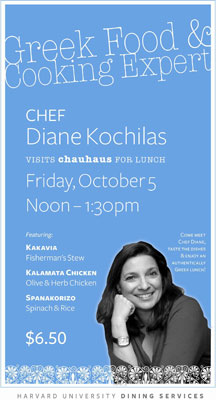 The country’s oldest collegiate foodservice operation partners with a noted authority to meet student demand for cuisine authenticity.
Authentic Greek fare is being introduced to the menus and students at Harvard thanks to collaboration between chef and cookbook author Diane Kochilas and Harvard University Dining Services (HUDS). Beginning last summer and extending into the fall, Kochilas and HUDS have developed recipes, trainings and tastings, which will culminate in more than a dozen new items for HUDS’ residential-dining winter menus.
Greek cuisine, regarded for its nutritional benefits through the use of plant oils, lean proteins, vegetables and distinct seasonings, is an ideal fit for Harvard menus where students are increasingly interested in authenticity and health. Seafood and vegetarian options that appeal to non-vegetarians are among the most demanded items on student surveys.
Kochilas was a presenter at the Spring 2012 Worlds of Healthy Flavors conference, hosted by the Harvard School of Public Health and The Culinary Institute of America. HUDS’ managing director, David Davidson, and director for culinary operations Martin Breslin were in attendance and immediately saw the opportunity for bringing Kochilas’ expertise to campus.
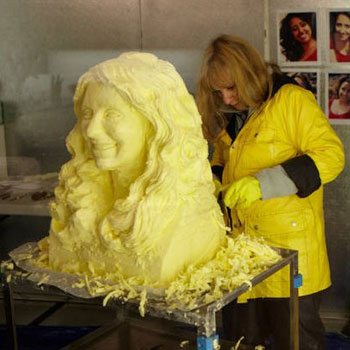 Saying that five times fast led to a college student’s likeness in Darigold butter.
 An interview with father and son Michel and Sébastien Bras of France.
 We need to remind our students that communication is an art that recognizes the dignity and importance of the receiver. In fact, have them consider taking the E-Mail Pledge.
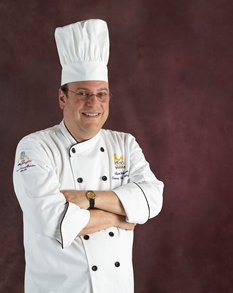 A must list that students should review frequently so they might keep their jobs in commercial kitchens.
 The Great American Can Roundup Industry Challenge raises more than $183,000 for charity.
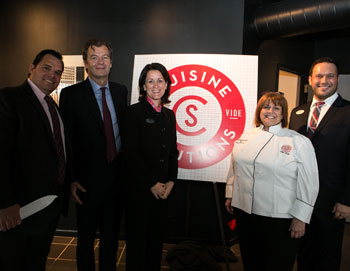 Building on its reputation for offering a professional culinary-arts program that is forward looking from the foundations of classical technique, Kendall College officially opened the doors to its new kitchen—the Cuisine Solutions Sous-Vide Training Kitchen—on October 19. The ribbon-cutting ceremony and dedication event was presided over by Kendall College President Emily Williams Knight.
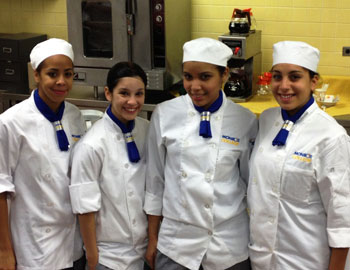 Twenty-eight Monroe culinary students set off October 19 in a downpour headed upstate to Delhi, N.Y., to compete at the Annual ACF Catskills Regional Competition. When they returned to the Monroe campus they had 27 shiny medals to add to their collection, which is now toppling 300!
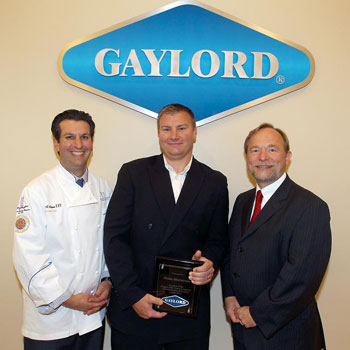 Gaylord Industries, commercial kitchen-air-management experts, and Niagara County Community College (NCCC) recently celebrated the opening of the new Niagara Falls Culinary Institute. The state-of-the-art facility, with 25 teaching kitchens and labs, opened in September 2012 with 350 undergraduate students who seek a future in the hospitality and tourism industries.