 Members of the American Culinary Federation are well aware of the quality and relevance of the organization’s official magazine, The National Culinary Review. The publication’s current success with readers and impact on the industry is due to its editor-in-chief for more than a decade, who recently received the highest recognition possible from her peers.
Courtesy of the International Foodservice Editorial Council
No one in the audience at The Betty award lunch on Nov. 4, 2014, during the International Foodservice Editorial Council (IFEC) annual conference in Dallas seemed surprised when the much-anticipated announcement came—except the awardee herself. (See photo.)
Kay Orde, editor-in-chief of the American Culinary Federation’s The National Culinary Review, was so focused on getting her camera ready to shoot the winner that it took her a moment to realize it was her name that was called.
A member of IFEC since 2003, Orde has served the organization in many capacities, including secretary of the board of directors, Chef Showcase co-chair (two years in a row) and member of the Professional Development Awards and Mentoring/New Member Orientation committees.
The Betty Bastion Outstanding Service Award, a.k.a. The Betty, is presented annually to celebrate one IFEC member who has provided extraordinary service to IFEC and the foodservice communications field and stands out as a knowledgeable and generous professional. Named for Betty Bastion Varese, who retired as IFEC’s first executive director in 1991, the award was inaugurated that year.
In nominating Orde for the 2014 award, Katie Ayoub, managing editor of Flavor & The Menu magazine and one of several IFEC members proposing Orde, said, “I have worked with her as both a writer, pitching article ideas, and as a publicist, pitching magazine placement. She has always been receptive, attentive and professional in those exchanges. Kay gives her heart and mind to IFEC, and I can think of no one more deserving of The Betty.”
IFEC member Mary Petersen, founder and president of CAFÉ, also nominated Orde. “I always appreciate Kay’s prompt and supportive feedback, as well as her keen editing skills,” Petersen wrote. “Kay is a kind professional with a willingness to help others in the IFEC community.”
Before becoming editor-in-chief of The National Culinary Review, Orde worked incommunications for the ACF in St. Augustine, Fla., producing the membership newsletter Center of the Plate. Her background includes: staff writer, The Chapel Hill News, Chapel Hill, N.C.; technical writer, Research and Evaluation Associates, Chapel Hill; staff writer/editor, Research Triangle Institute, Research Triangle Park, N.C.; freelance writer, Durham Morning Herald, Durham, N.C.; and several area magazines. Prior to joining the ACF, she taught English at Flagler College in St. Augustine.
A graduate of the University of North Carolina at Chapel Hill with a bachelor’s degree in journalism and honors in creative writing, Orde earned a master’s degree in English and environmental studies at North Carolina State University, Raleigh. She lives in St. Augustine with her husband, celebrated novelist Lewis Orde. The couple has two married daughters and three grandchildren.
According to IFEC, the 2014 presentation was especially exciting, opening with a video celebrating past recipients (24 in all) leading up to 2013 Betty honoree John Scroggins of Noble Communications +, Springfield, Mo., announcing Orde. The original Betty (Bastion Varese) and 15 previous Betty winners were on hand to help congratulate Orde.

 The Culinary Institute of America and Restaurant Associates announce a new partnership designed to accelerate innovation in contract-foodservice operations of the future.
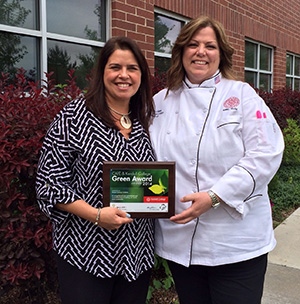 For a seventh year, Kendall College will sponsor the CAFÉ/Kendall College Green Award, the industry’s premiere program lauding successes of culinary-arts and hospitality-management programs that practice and train students in ecological responsibility.
 The annual menu-trends survey of chefs conducted by the National Restaurant Association discovered that culinary cocktails, doughnuts and brown rice are gaining in popularity among customers, while kale salads, housemade sodas and hybrid desserts are cooling down.