
Kendall College Wins 2015 National Baron H. Galand Culinary Knowledge Bowl
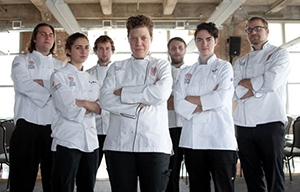
A team of five students enrolled in the Kendall College School of Culinary Arts’ associate and baccalaureate programs on beat three other teams to win the 2015 National Baron H. Galand Culinary Knowledge Bowl on Aug. 1 at the American Culinary Federation’s (ACF) National Convention & Show at the Orlando (Fla.) World Center Marriott.
Their success reclaims the title and is the third win for a Kendall College team in the last six years of this national competition. Earlier this year in Indianapolis, the Kendall team swept the annual regional competition for a sixth consecutive year to qualify for the national final.
The Kendall College team, consisting of Alex Gabrielson (captain; Pella, Iowa), Michael Lanzerotte (Bloomington, Ill.), Emily Mankus (Lincolnshire, Ill.), Nelia Salvi (Madison, Wis.) and Alex Szabo (Prescott, Ariz.), competed against student teams from professional foodservice-training programs at schools in Riverhead, N.Y., Savannah, Ga., and Kirkland, Wash., representing the ACF’s Northeast, Southeast and Western Regions, respectively. Culinary student Mike Kubiesa (Elmhurst, Ill.) served as a second alternate on Kendall’s team.
Educators Invited to Inaugural Olive Oil Conference in Chicago
The North American Olive Oil Association(NAOOA), a nonprofit group that promotes the health, versatility and authenticity of all types of olive oil for North American consumers, announces registration is open for its Inaugural Olive Oil Conference—“Spend Wisely on Olive Oil”—to be held Aug. 25 and 26 at the Westin O’Hare near Chicago in Rosemont, Ill.